

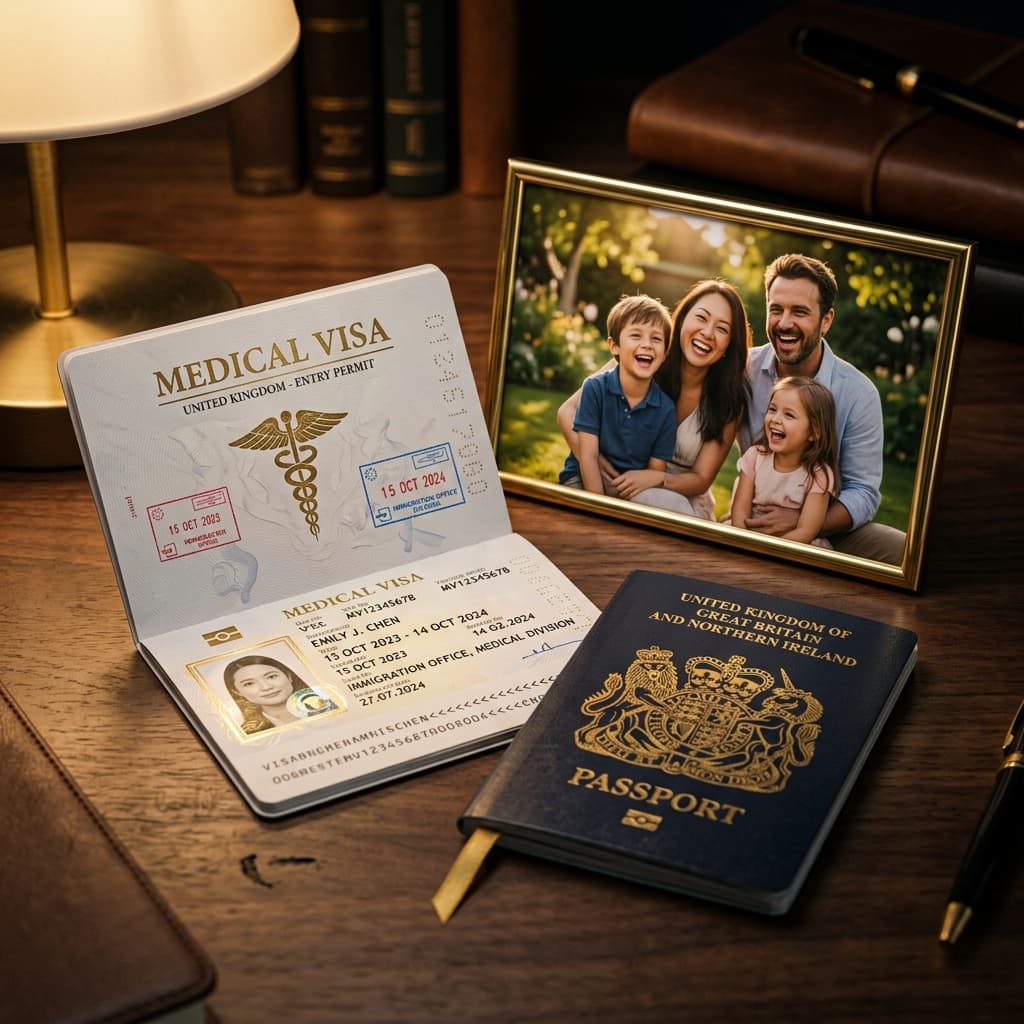
The first sounds like paperwork. The second sounds like a feeling. But for most patients we work with, they are the same question — will I have to do this alone?
This guide answers both, plainly:
- A clear, step-by-step roadmap to the medical visa, with the documents, timelines, and pitfalls in one place.
- A direct answer on family accompaniment, including who qualifies, what they need, and how to bring them along.
- A printable Medical Visa Document Checklist at the end of this PDF that you can use today.
You will not need a lawyer to follow this. You will not need to memorize anything. You will need about ten minutes to read it.
Section 1: The Medical Visa — A No-Nonsense Step-by-Step Guide
What is a medical visa?
A medical visa is a specific visa category designed for patients traveling for treatment — not for tourism, not for business. It exists because medical treatment requires a longer stay, more documentation, and often the right to bring family attendants along.
Common examples for international patients:
- India — Medical Visa (MED): typically valid for up to 60 days from arrival, with up to three entries. Extensions are possible while you are in India for ongoing treatment.
- Turkey — Medical Visa (e-Visa or sticker): short-stay treatment visa, with extensions available through provincial migration offices.
- Thailand — Medical Treatment Visa (Non-Immigrant MT): 60-day initial stay, extendable.
- United Arab Emirates — Patient Entry Permit: short-stay permit issued via partner hospitals.
- Germany / Schengen — Schengen visa with medical purpose: short-stay (up to 90 days), with separate national visas for longer treatment.
Every country writes its own rules. The principles below apply almost universally.
Who qualifies for a medical visa? (A simple checklist)
A medical visa is intended for patients who:
- Have a diagnosis or referral from a recognized doctor or hospital.
- Have a planned, scheduled treatment at an accredited hospital in the destination country.
- Are not arriving on an emergency tourist trip — emergencies are handled differently and usually after entry, not before.
- Can demonstrate financial means to cover treatment, accommodation, and return travel.
- Have valid travel documents with sufficient remaining validity (typically at least 6 months).
If those five points describe your situation, you almost certainly qualify.
The Five-Step Application Process
Step 1 — Secure a medical invitation letter from the hospital
This is the single most important document in your file. Without it, no embassy will issue a medical visa. Without it written correctly, you will be delayed.
A strong medical invitation letter is on official hospital letterhead and includes:
- Your full legal name (matching your passport exactly)
- Your diagnosis and the proposed treatment plan
- The expected duration of treatment, including hospitalization and recovery
- The treating doctor's name, registration number, and contact details
- An indicative cost estimate, broken down by procedure
- Confirmed appointment dates if available
- A line stating whether a medical attendant (family companion) is recommended
Tip: if your invitation letter does not include a medical attendant recommendation, ask the hospital to add one before it is signed and stamped. This single sentence is what allows your spouse, parent, or child to apply alongside you.
Step 2 — Gather your primary documents
A typical patient document file contains:
- Passport with at least 6 months of validity beyond your planned return date, and at least two blank pages
- Two recent passport-size color photographs
- Confirmed or provisional flight itinerary
- Proof of funds (recent bank statements covering the last 3–6 months)
- Recent medical reports, scans, prescriptions, and prior treatment history
- The hospital's medical invitation letter
- Cover letter explaining your treatment purpose, in plain language
Step 3 — Fill out the visa application form accurately
Most rejections happen here, not at the embassy interview. The most common avoidable mistakes:
- Names that don't exactly match the passport
- Mismatched dates between the application form, the invitation letter, and the flight itinerary
- Leaving fields blank instead of writing "N/A"
- Selecting the wrong visa category (tourist vs medical)
- Listing the wrong port of entry
- Inconsistencies between current address on the form and on bank statements
Read every field twice. If a question is genuinely not applicable, write "N/A" — don't leave it empty.
Step 4 — Pay the visa fee and submit at the embassy or visa center
Most countries process medical visas through a visa application center (VFS Global, BLS International, TLScontact, or similar) on behalf of the embassy.
- Pay the visa fee online or at the center
- Book a biometrics appointment (fingerprints + photo)
- Submit your physical document file
- Receive a tracking number to follow your application's status
Step 5 — Track your application and receive your visa
Typical processing times for medical visas:
- India MED visa: 5–10 working days when documentation is complete
- Thailand MT visa: 5–15 working days
- Turkey medical visa: 7–15 working days
- Schengen with medical purpose: 15–30 working days
Where the case is genuinely urgent, many embassies and visa centers offer priority or emergency processing — for an additional fee, and only with strong documentation showing time-critical treatment. Your medical travel coordinator can advocate for priority processing on your behalf with a formal request from the treating hospital.
Pro-tips for a smooth approval
- Make sure the medical invitation letter is on official hospital letterhead with a visible registration number, address, and contact details.
- Show strong ties to your home country: property documents, employment letter, business registration, school enrollment of children.
- Do not book non-refundable travel until your visa is stamped.
- Keep your medical reports recent — most embassies want reports issued within the last 90 days.
- If you have traveled abroad recently, include those visas.
- Be ready for the embassy to call your hospital to verify the invitation letter.
Section 2: "Can My Family Come With Me?" — Yes. Here's Exactly How.
No one should heal alone. Almost every major medical-visa-issuing country has a specific category that allows close family members to travel with you.
The medical attendant visa
Most countries call it a Medical Attendant Visa or Companion Visa.
Examples:
- India: MED-X visa
- Thailand: Accompanying Person category
- Turkey: Companion-linked tourist visa
Common rules across most destinations:
- Usually up to two close family members can apply as medical attendants
- Their visa is issued for the same duration as the patient's medical visa
- They are not permitted to take up paid work
- Their application is directly linked to the patient's medical visa application
The application process for accompanying family
Each attendant submits:
- Their own valid passport
- Two recent passport-size photographs
- Proof of relationship to the patient
- A copy of the patient's medical invitation letter
- A copy of the patient's medical visa application or stamped visa
- Their own travel itinerary
- Proof of funds
In most cases, attendant applications are submitted at the same time as the patient's application.
Important nuances most guides skip
- Can a medical attendant work in the destination country? No.
- Does the attendant need their own health check? Usually no, except vaccination requirements.
- Can extra family members visit later on a tourist visa? Often yes.
- What if my attendant is a minor? Minors generally need a notarized parental consent letter.
- What if I'm a single parent traveling with a child as my attendant? Additional notarized consent or proof of sole custody may be required.
- Can my attendant arrive later or leave earlier than me? Yes, if their dates are listed correctly on the application.
Beyond the visa — holistic support for the family
A good coordinator will arrange family accommodation near the hospital, dietary preferences, local SIM cards, interpreter support, companion care, local transportation, and recovery-phase outings. Healing is faster when patients are not alone.
Section 3: The "We've Got You" Edge
Common pitfalls — and how a coordinator catches them
A retired teacher from East Africa was preparing to fly to India for a heart valve replacement. Her visa application was complete — except her medical invitation letter did not include the line confirming that her daughter would travel as a medical attendant. Her coordinator caught the issue before submission. The hospital reissued the letter with the attendant clause included. Both visas were issued in 6 working days. Her daughter held her hand on the morning of surgery.
A note from your patient coordinator
"You're not a case number to us. In our daily calls before you travel, we don't only check your documents — we ask how you're feeling about the trip. We ask about your sleep. We ask whether your family at home is okay with you going. Those things change how a treatment goes more than people realize. That's the care you deserve, and it's the care we promise."
Conclusion: Healing With Your People Beside You
Getting a medical visa, and bringing your family with you, doesn't have to feel overwhelming. With the right preparation — and a partner who treats you like family, not a file — you can put your full attention where it belongs: on healing.
What to do next:
- Use the Medical Visa Document Checklist
- Talk to the visa concierge team
- Send your reports for a free case review
About the author
This guide was prepared by the Medical Travel Liaison Team at Genesys Voyage. Genesys Voyage supports international patients with visa support, hospital matching, medical travel coordination, and 90-day post-discharge follow-up.
Trust signals:
- Assisting 1,000+ patients annually
- Partner hospitals across India
- 24/7 multilingual coordinator support
Appendix: Medical Visa Document Checklist
Patient documents
- Passport valid for at least 6 months
- At least 2 blank passport pages
- Passport-size photographs
- Flight itinerary
- Proof of funds
- Recent medical reports
- MRI / CT / X-ray / ultrasound reports
- Prior treatment history
- Medical invitation letter
- Cover letter
- Completed visa application form
- Visa fee receipt
- Biometrics appointment confirmation
- Strong-ties evidence
- Copies of previous visas
Family / medical attendant documents
- Valid passport
- Passport photographs
- Proof of relationship
- Copy of invitation letter naming the attendant
- Copy of patient's medical visa application or stamped visa
- Travel itinerary
- Proof of funds
- Consent letter if required
- Vaccination certificates if required
Final pre-submission review
- Names match exactly across all documents
- Dates match across all documents
- Correct visa category selected
- Port of entry matches flight booking
- Photocopies kept safely
- Tracking reference saved
- Coordinator has full file copy
Need help with any of the above? Send your reports for a free case review within 48 hours.